
One of the fun parts of designing and building sets is the knowledge that you are also going to be removing it. Planning on it actually. What parts are going to be saved for another set. Which are going to be taken apart for material and which are just trash. Knowing that is how you know where to be careful and where to just rip-it-out!
It also makes the process quicker since you know where all the screws are! This is a huge help. There is no way to explain just how much time and aggravation this saves. If you have ever been completely stumped as to why something will just not come off/up/over/away and you are sure there is no other place for a fastener, you know what I mean. Then there is the one that only a tiny person with two elbows on the same arm could possibly have put where it is. No normal size arm and hand, holding a regular tool could get in there. Not ever!
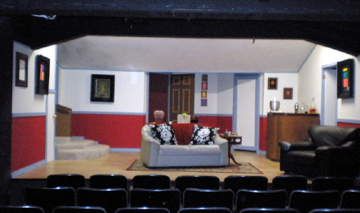
Then there is the part about two plus weeks of intense, detailed, hard ass work to get the thing up and right as quickly and inexpensively as possible. Long, long, long days and night. Calls and emails about what needs to be where, to work how, to turn on or off, move which way and how many times? The minutia of what color should the towels be and one or two? Would that character really have that kind of art work? Fake flowers or real? Etc Etc Etc
I tried to describe the process to someone and the analogy of the four seasons came to mind.
Winter is the when the dressing goes back on the shelves. Art work, curtains, furniture, all that make a ‘place’ what it is. Bedroom, office, jail, airplane, diner or living room. It is all these things that allow the theater goer to ‘suspend reality’ and get into the story. Winter is when things die or become dormant. Much like the set. First the ‘place’ ceases to be a place. Then in many cases, even the walls come down.
Spring is next. Spring is the meetings with the director, the art director the lighting designer. This is when the new place begins to take shape. The soil is prepared, fed and readied for a seed. The seed is the desire for an X place. With X color scheme. After it has been sown, the seed begins to grow. This is the lay out on the floor in blue tape. The sharpie notes on floor, walls, tape, even on people on occasion! Once the form is in place, the idea needs to become a place. It is sprouting!
A flurry of growth occurs as walls, door, windows make it into place. The painting is like the buds – so close to being ready, mature, grown up! Just a few more days of sunshine… and Viola! We have 80% of a place. Now the furniture, the art, the bits and pieces of real stuff.
Summer is quickly in place as the actors take to the stage as it is intended, not just an idea or work in progress. They have taken the written word of a stranger and, committing to memory, have created a living, breathing, mobile version of those words. Summer is when the story is living its fullest in the presence of an audience, transported into another place, time, tale. Summer is hot but on occasion cool. There are cool summer breezes as well as hot summer rains. Shows are the same. Some are hot as hell yet the very next day is a rain storm. This is the beauty of live theater. Every single performance is unique.
Fall is a funky season in the way, life of a set. I see it as the closing weekend. The show has matured and (usually) has become a bit different from opening-night. There is a flow and confidence that only comes from repetition. The energy is high but also the expectation that this is the last weekend! Ugh! Equally happy and sad feelings are common among cast and crew. You get close doing a show. You also know that once it ends, you are not close anymore. Fall is just that – everything begins to fall away in preparation to disappear altogether. Fall is as lovely as it is ugly.
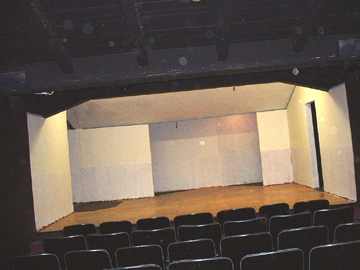
And back to winter. The cycle is endless as long as there is money to keep the doors open and people willing to volunteer their time and talent to the projects.
This past winter/spring I saw something that had only recently been asked of me. “After all this time, how thick is the paint on these walls”? At the time I was intrigued by the question. A lot I am sure. Years worth. But what does that look like I wondered?
As this set went from white to black I decided to repair a section of wall that has actually been bugging me for a decade. Why is this big lump here? Only way to find out is to break into it. Much to my surprise and delight the lump was easy to get into. It was a thick, semi-flexible chunk of – PAINT! Once I cut it way with my razor knife I discovered the source of my bump. A staple. One staple. It was painted over and the paint ran down the wall. The staple and the run were painted over again. And again, and again and again………..
The lump was near twenty four inches long and near the top, over a quarter inch thick. In pealing away the paint (a section eight inches wide and thirty inches long I removed a sheet of paint three eighths of an inch think. When sliced at an angle, the paint layers looked like strata in the rock cliffs of a desert. Over all, I would guess we have lost a full half inch of stage due to paint build up! No idea what to do but take the walls down and replace. An idea in play actually but for other reasons. This may just be a bonus!
I just wanted to tell you about the seasons of and the strata effect of set building. The creating and de-creating of places.
A V


 The Gori Details
Leave a comment